Buying Trading Card Stock for a Vending Machine: A Traceability Checklist
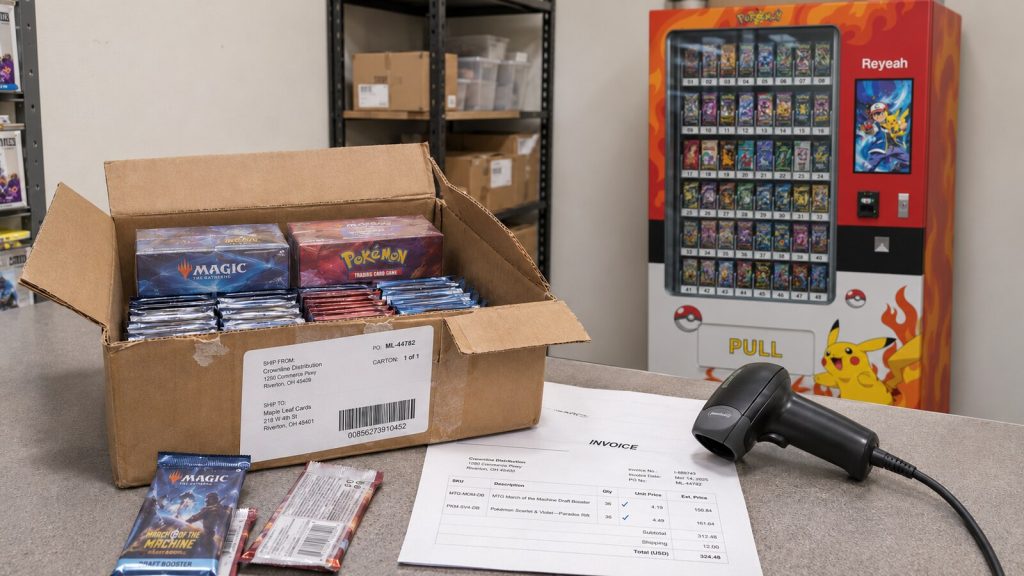
Traceable trading card vending stock matters when a customer questions a booster pack bought from a machine. The operator needs more than a reassuring answer. The useful questions are specific: where did this stock come from, which delivery did it belong to, and what exactly did the listing promise?
A simple traceability process helps answer those questions. It also makes ordinary stock errors easier to find before they become customer disputes.
Record the source of your trading card vending stock
Keep invoices and receiving records together. Include the supplier’s business details, order reference, delivery date and the product identifiers available on the packaging. Record the game, set, language, quantity and retail format.
A description such as “Pokémon cards” is not enough for an inventory record. Sealed boosters, sleeved boosters, collection boxes and individual cards represent different purchases. They should not be interchangeable in a stock sheet.
Ask suppliers about the origin of their inventory and retain the response. A low price or a familiar-looking package is not, by itself, evidence of authenticity. Avoid claiming that every item has been independently authenticated unless you have a process that supports that statement.
Inspect stock before mixing deliveries
Set aside time to inspect incoming cartons before their contents join older stock. Compare the received product with the order and check for opened packaging, inconsistent labels, crushing, moisture or signs of tampering.
Photograph questionable items and separate them from saleable stock while the issue is resolved. Do not put them into a vending lane with the expectation that the customer will decide whether they are acceptable.
Packaging can change legitimately, so visual differences are a reason to investigate rather than automatic proof of a counterfeit. Keep the supplier communication with the receiving record.
Preserve the link to each refill
Give each incoming delivery an internal reference, even when the product has no convenient batch identifier. When stock is loaded, record the machine, lane, date and quantity against that reference.
If several deliveries are mixed in a lane, record the mix. A precise inventory history is easier to maintain if staff finish or separate one delivery before introducing another, but the process must reflect what actually happens.
When an item is removed during maintenance, record that too. Otherwise the stock report can suggest a missing sale when the product is sitting in a technician’s bag.
Describe sealed and repacked products differently
Customers should be able to distinguish manufacturer-sealed retail products from anything assembled or repacked by an independent seller. If the machine sells ordinary sealed packs, use accurate product names and photographs of those packs.
For any seller-created assortment, make its origin, contents and selection method clear. Do not present it as a manufacturer-issued sealed product or imply guaranteed rare-card outcomes. Avoid value promises that cannot be substantiated.
The operator’s identity matters as well. An independently operated cabinet selling genuine cards is not the same thing as a brand-operated retail programme.
Do not confuse equipment with official affiliation
Pokémon Center’s official vending-machine FAQ states that its machines are owned and operated by The Pokémon Company International and are not offered for sale. An equipment purchase from an independent supplier should therefore not be presented as entry into that official programme.
Use product and business descriptions that accurately reflect your own operation. Obtain appropriate advice about proposed branding and artwork rather than assuming that selling a product automatically settles permission to use every related image.
Prepare for a complaint before one arrives
Display a working support contact and a way to identify the machine. Ask customers for the purchase time, product and transaction reference; avoid requesting full card details.
Compare the complaint with the payment record, delivery event and refill history. Keep photos and correspondence together, and explain the outcome in plain language. A traceable operation cannot prevent every problem, but it can investigate a disputed pack without guessing.
Once stock handling is settled, the Pokémon vending machine location guide covers a separate decision: finding a suitable place to operate.