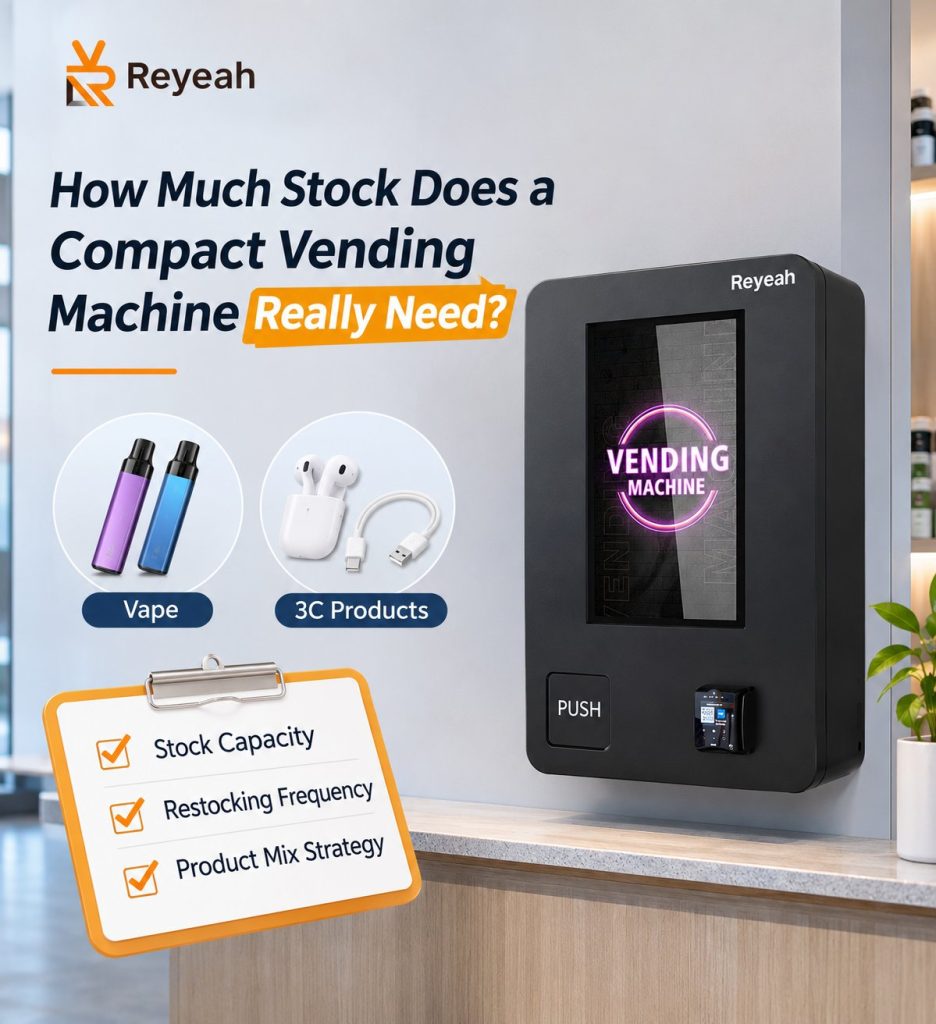
How Much Stock Does a Compact Vending Machine Really Need?
A compact vending machine that looks full can still be losing sales. Several slow products may remain untouched while the item people came to buy has been unavailable since yesterday. In a compact cabinet, that imbalance matters more because there is little spare space to absorb mistakes.
The purpose of a stock plan is to keep useful products available between visits without filling every gap with inventory that does not move.
Plan compact vending machine stock around the next visit
Use the time between realistic refill visits as the starting point. A machine inside your own shop may be checked every morning. A machine across town may have to wait several days, and access to the building may be limited to certain hours.
For each product, estimate demand over that interval and add a buffer for ordinary variation. A simple planning calculation is average daily unit sales multiplied by days between visits, plus buffer units. Treat it as a starting estimate and revise it after observing the site.
For example, four units per day over four days, plus six buffer units, gives a target of 22. If the tested lane capacity is only 16, the plan needs changing. Another lane, a shorter interval or a different product format may solve the problem. These numbers illustrate the method; they do not predict a particular location’s demand.
Separate a weak product from an empty lane
Sales records need availability records beside them. A product that sold nothing on Saturday may have been unpopular, or it may have sold out on Friday. Those situations require different decisions.
Record the count at each refill, the time a lane became unavailable where the system provides it, and any delivery fault. Compare sales on days when the product was actually available. Otherwise, an empty best seller can look like a poor performer and lose its shelf space.
The same applies to a lane disabled by a jam. Replacing its product without addressing the fault will not fix the underlying problem.
Give space to demand, not to symmetry
A balanced display is pleasant to look at, but equal space for every item is rarely a sensible operating rule. Keep a small core of products available consistently. Give successful items additional capacity when the figures justify it, and reserve limited space for trials.
Change one part of the assortment at a time. If you replace several products, move their positions and change prices in the same week, it becomes difficult to explain the result. Keep a dated loading plan so the sales report can be matched to what was on the shelf.
Pack refills before leaving
A basic route sheet can list the machine, product, current count, target count and quantity to bring. Add any parts or cleaning supplies required. Packing this stock in advance reduces time spent sorting boxes in a public corridor.
Treat expiry checks and packaging checks as part of the refill. Rotate dated stock so earlier-expiring units are sold first where appropriate, and remove damaged packs. For chilled products, handling and storage need to follow the product requirements and the site’s food-safety procedures.
Count the products physically rather than trusting a dashboard indefinitely. Failed deliveries, manual removals and incorrect refill entries can cause the recorded balance to drift.
Price the journey as well as the stock
An extra visit has a cost even when the owner does the work. Include travel, parking, building access, replenishment and administration time when comparing a smaller cabinet with a larger one.
Review the plan after a full cycle of normal operating days, including weekends or shift changes where relevant. Look at unavailable products, unsold stock and time spent per visit together. The right capacity is the amount that supports a workable route and a dependable selection, not the largest number printed on a specification sheet.