Smart Vending Cabinet Payments: Explaining Holds, Final Charges and Refunds
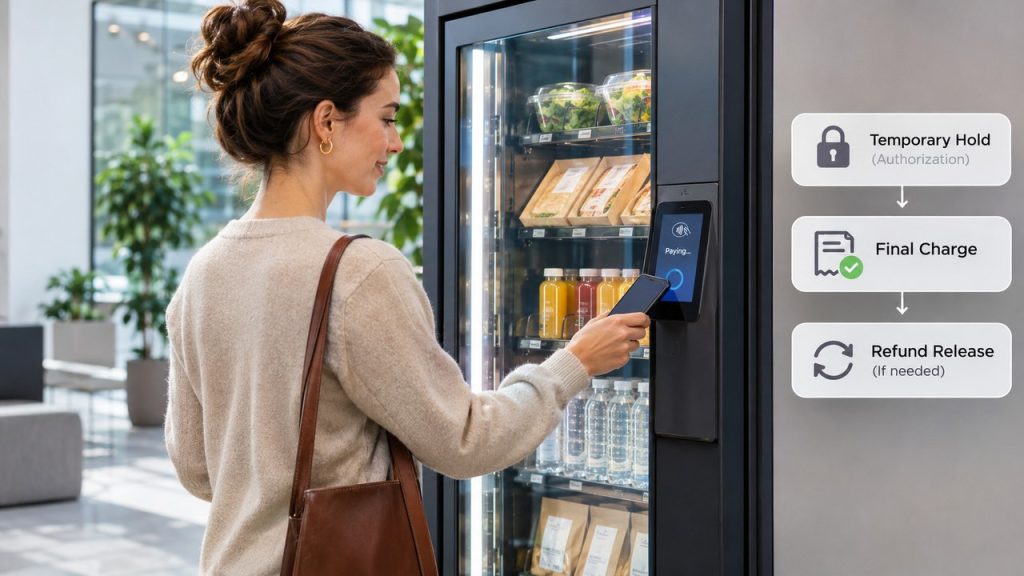
Smart vending cabinet payments can confuse customers when a temporary card hold looks like a completed charge. Someone takes a drink, checks their banking app and sees an amount larger than the drink’s price. They may assume they have been overcharged, even when the entry is a temporary authorization rather than a completed payment.
The operator needs to understand the payment flow well enough to explain it. A vague instruction to “wait a few days” is not a substitute for checking the transaction.
Establish the smart vending cabinet payment sequence
Some cabinets request an authorization before unlocking and calculate the final basket afterwards. Other systems use a different sequence. Obtain a written explanation from the payment provider for the configuration you are deploying.
An authorization reserves an amount; capture completes the charge for the relevant amount under the provider’s rules. The distinction is explained in Stripe’s guide to authorization and capture. That general explanation should not be treated as a promise that every cabinet or payment provider follows identical timing.
Confirm the authorization amount, how the final total is calculated, and what happens when the customer opens the door but buys nothing. Ask which payment methods support the proposed flow in your market.
Explain the hold before the customer starts
If the machine uses a temporary hold, display that fact and the amount before payment authorization. Explain that the final charge is based on the completed purchase. Keep the wording consistent between the terminal, cabinet screen and support materials.
Do not promise an exact release time unless the provider can support it for the transaction concerned. The customer’s bank may display pending and completed entries differently. A clear receipt helps customers distinguish the actual basket from a pending entry.
A short explanation in the right place is more useful than a long notice hidden behind a help button.
Investigate the transaction before choosing a remedy
Support staff should first identify whether the customer is describing a pending authorization, an incorrect captured amount, a duplicate completed payment or a basket they dispute.
A pending entry and an incorrect completed charge require different checks. Issuing an unrelated refund without understanding the original payment can complicate reconciliation. Use the provider’s supported process and confirm which transaction is being corrected.
Ask for the machine identifier, approximate purchase time and receipt reference. Request only the payment information the provider’s process requires. Customers should not send full card numbers, security codes or photographs of payment cards.
Match three records
For each reported problem, compare the cabinet’s basket record, the payment provider’s transaction status and the customer’s receipt. A recognition error may produce an incorrect basket even when the payment system has processed it correctly.
Conversely, the basket may be accurate while capture is delayed or unsuccessful. Treating every complaint as a sensor fault wastes time and leaves payment problems unresolved.
Record the finding and action taken. If a correction is issued, keep its reference with the original transaction so another staff member can answer a follow-up without repeating the investigation.
Test recovery before going unattended
During commissioning, ask the provider to demonstrate a no-purchase session, a cancelled session and a failed payment. Confirm that the cabinet and dashboard end in a consistent state.
Also test how staff find a transaction when the customer has no printed receipt. The investigation should remain possible without guessing from a long list of similar amounts.
Agree who owns each part of support: the venue, the machine operator, the equipment supplier and the payment provider. Give customers one clear starting contact, even if several companies are involved behind the scenes.
Review repeated complaints by type. Frequent confusion about holds calls for clearer instructions; repeated incorrect baskets call for a recognition review. A reliable payment experience depends on the transaction working and the customer being able to understand what happened.